Sheridan, WY, April 14, 2026 (GLOBE NEWSWIRE) -- Global Environmental Impact Solutions (GEIS) announced today that it has been accepted as an Innovator at the EarthX 2026 E-Capital Summit, taking place April 20–22, 2026 at the Hilton Anatole in Dallas, Texas. The acceptance recognizes GEIS for what it has built: the Plastic Impact Protocol v4.2 — the first published, versioned, and publicly auditable governing standard for plastic credits ever produced by any organization in the world — and the technical, legal, and physical infrastructure required to enforce it at the kilogram level.
GEIS is an EarthX E-Capital Summit Innovator
The announcement comes at a pivotal moment. The global plastic credit market was valued at $462 million in 2024, projected to reach $1.79 billion by 2031 at a 23.6% CAGR and $4.2 billion by 2050. Yet the market's largest potential buyers have spent years publicly refusing to participate — not because they reject the concept, but because no program has offered what they have explicitly asked for: a credible, harmonized, publicly auditable governing standard they can read, cite, and hold accountable. GEIS published that standard on April 2, 2026. The same day, the EPA and HHS announced $144 million in ARPA-H funding targeting microplastics under the STOMP initiative — adding federal momentum to a market GEIS has been building the infrastructure for since its founding.
KEY STATISTICS:
• 574 Registered Investors at EarthX E-Capital
• 38 Incubators & Accelerators
• 23 Countries Represented
• $462M — Plastic Credit Market Today (Valuates Reports / QYResearch, July 2025)
• $1.79B — Projected by 2031 at 23.6% CAGR (Valuates Reports, July 2025)
• 0 — Published Governing Standards Before GEIS (GEIS Research, April 2026)
THE MARKET HAS BEEN ASKING. FOR YEARS. IN PUBLIC.
The withdrawal of institutional buyers from the plastic credit market has not been quiet. The world's largest consumer goods companies — the very organizations whose procurement decisions will determine whether this market scales to its $4.2 billion potential — have stated on record why they will not participate. Their language is consistent: the market lacks a governing standard. What follows are their words, not interpretations of them.
"We don't believe in the effectiveness of plastic credits without a credible, solid, and harmonized global standard."
— Nestlé, Official Company Website, nestle.com
"We believe there is a need for standardized methodologies to measure the impact of voluntary initiatives."
— Danone, Official Spokesperson, Trellis / GreenBiz
These are not fringe objections from sustainability skeptics. Nestlé and Danone are among the largest plastic-producing consumer goods companies on earth. Their procurement teams represent exactly the institutional buyer demand that would scale this market — and they are telling the market, publicly, what it must produce before they will engage. No organization has answered that demand. Until now.
WHY TWELVE ORGANIZATIONS FAILED TO BUILD WHAT THE MARKET NEEDED
GEIS conducted exhaustive research into every organization that has attempted plastic credits, on-chain plastic impact, or closely related environmental credit systems before building a single line of protocol. The findings were not ambiguous. Across twelve organizations, sixteen structural failure modes were documented in published investigations, peer-reviewed research, regulatory audits, and the public statements of the programs themselves. These are not allegations. They are the sourced, established record of a market that has been operating without adequate infrastructure.
FAILURE — INCINERATION AS RECYCLING
PCX Markets: 86% of credits from burning plastic in cement kilns (SourceMaterial, Nov 2023). AFP/SourceMaterial analysis of four major marketplaces: only 25% of all credits issued were for actual recycling. Communities near Cambodia's Chip Mong Insee kiln report respiratory illness and persistent health decline. Buying companies including Celebrity Cruises and EY did not respond to press inquiries.
THE GEIS ANSWER: Reserved Annex C is an architectural gate. No Plastic Impact Credit may be issued for any incineration-based pathway until GEIS publishes a formal activation notice with a technology-specific environmental methodology. Section 5 Methodology A explicitly excludes co-processing in cement kilns, waste-to-energy, and all incineration-based endpoints. There is no mechanism inside Protocol v4.2 to produce a plastic credit from burning plastic.
---
FAILURE — ADDITIONALITY FRAUD
Verra: 83% of plastic offsetting projects lacked additionality — they were already operating before credits were issued. Eight projects completed full 7-year crediting periods before their first credit was sold. Credits funded nothing that would not have happened anyway. Source: Break Free From Plastic / GAIA, November 2023.
THE GEIS ANSWER: Protocol v4.2 Section 6: Three mandatory independent additionality tests at design stage — barrier, common-practice, and economic plausibility. Revalidation required at renewal with a full baseline refresh. The GEIS dApp embeds additionality evidence at the individual human level: direct payment to a named person, verified weight, GPS-confirmed location, system-locked timestamp. No competitor can evidence additionality at this granularity.
---
FAILURE — AUDITORS WHO WEREN'T AUDITING
PCX: 60% of net-zero-certified credit records had no third-party auditor. All major programs permit volume-based verifier compensation — auditors paid more when more credits are issued, creating a direct financial incentive to approve rather than reject. Verra's own investigation found 90%+ of rainforest credits were 'likely junk.' Source: Break Free From Plastic / GAIA, November 2023.
THE GEIS ANSWER: Protocol v4.2 Section 11: Volume-based compensation for validators and verifiers is prohibited under any structure — absolute. Independence declarations signed and retained. A 5% Major Discrepancy threshold creates a published, quantitative trip-wire. Site visits and surprise checks authorized. Appendix 3 requires verifiers to assess field-to-facility reconciliation and individual participant payment integrity — not just paperwork.
---
FAILURE — CERTIFICATE FRAUD AT SCALE
India CPCB audit 2023: 600,000–700,000 fake plastic recycling certificates generated by just 4 companies — 38 times their actual processing capacity. Rs. 355 crore in regulatory fines. UK: Environmental Investigation Agency found 10–15% of all plastic recycling certificates fraudulent — £30–50 million in fraudulent claims annually. EPR systems with no field inspection, no reconciliation, and no chain-of-custody trail become fraud-at-scale. Source: India CPCB / Down to Earth / CSE, Oct 2024; EIA, Oct 2024.
THE GEIS ANSWER: Protocol v4.2 Section 10.3: Field-to-Facility Weight Reconciliation is mandatory protocol-level infrastructure. Field collection weight and facility intake weight must both be documented. The delta must be explained and verified before any batch can close. The Integrity Lock Flag at the database level prevents the same verified kilograms from supporting more than one issuance. The dApp Submit button is physically disabled without a weight ticket and location record attached. This is the architecture India and the UK did not have.
---
FAILURE — WASTE COLONIALISM
100% of all major plastic credit operations — Verra, PCX, Plastic Bank, rePurpose Global, CleanHub, Tontoton, Empower, BVRio — concentrate collection burden exclusively in developing nations: Philippines, Indonesia, Cambodia, India, Kenya, Brazil, Haiti, Ghana. Researchers have named this pattern 'waste colonialism' (Moon et al., ScienceDirect 2025). These communities bear the health costs. Corporations buy neutrality. No U.S.-licensed, federally regulated infrastructure exists in any competitor program.
THE GEIS ANSWER: GEIS builds exclusively through licensed U.S. Materials Recovery Facilities — federally regulated, generating weight documentation under applicable U.S. law. This is the only plastic credit program in the world with U.S.-soil, federally regulated infrastructure. This is also the only program qualified as an SDVOSB, creating a federal contracting demand floor that is independent of volatile voluntary ESG markets and cannot be replicated by any foreign-focused competitor.
---
FAILURE — TOKEN BURN AS CREDIT RETIREMENT
Toucan Protocol bridged 21.6 million carbon credits on-chain in 6 months. CarbonPlan (April 2022): most were 'zombie' credits — dormant because the market had already determined they lacked environmental value. KlimaDAO spent $1M+ retiring its own worst credits. BCT token fell 50%+; KLIMA token collapsed. Verra suspended credit tokenization May 2022. Burning a token on-chain does not equal retiring a plastic credit.
THE GEIS ANSWER: Protocol v4.2 Section 13: Registry Supremacy. The GEIS Registry is always the authoritative record. A token burn is valid only if the Registry simultaneously sets the corresponding units to RTRD status. Burning a token without Registry RTRD does not constitute a valid impact claim. No mechanism for zombie credits: mint events require prior Registry issuance approval. The on-chain token is derivative — always subordinate to the Registry, never a replacement.
THE PLATINUM STANDARD — WHAT PROTOCOL v4.2 ACTUALLY GOVERNS
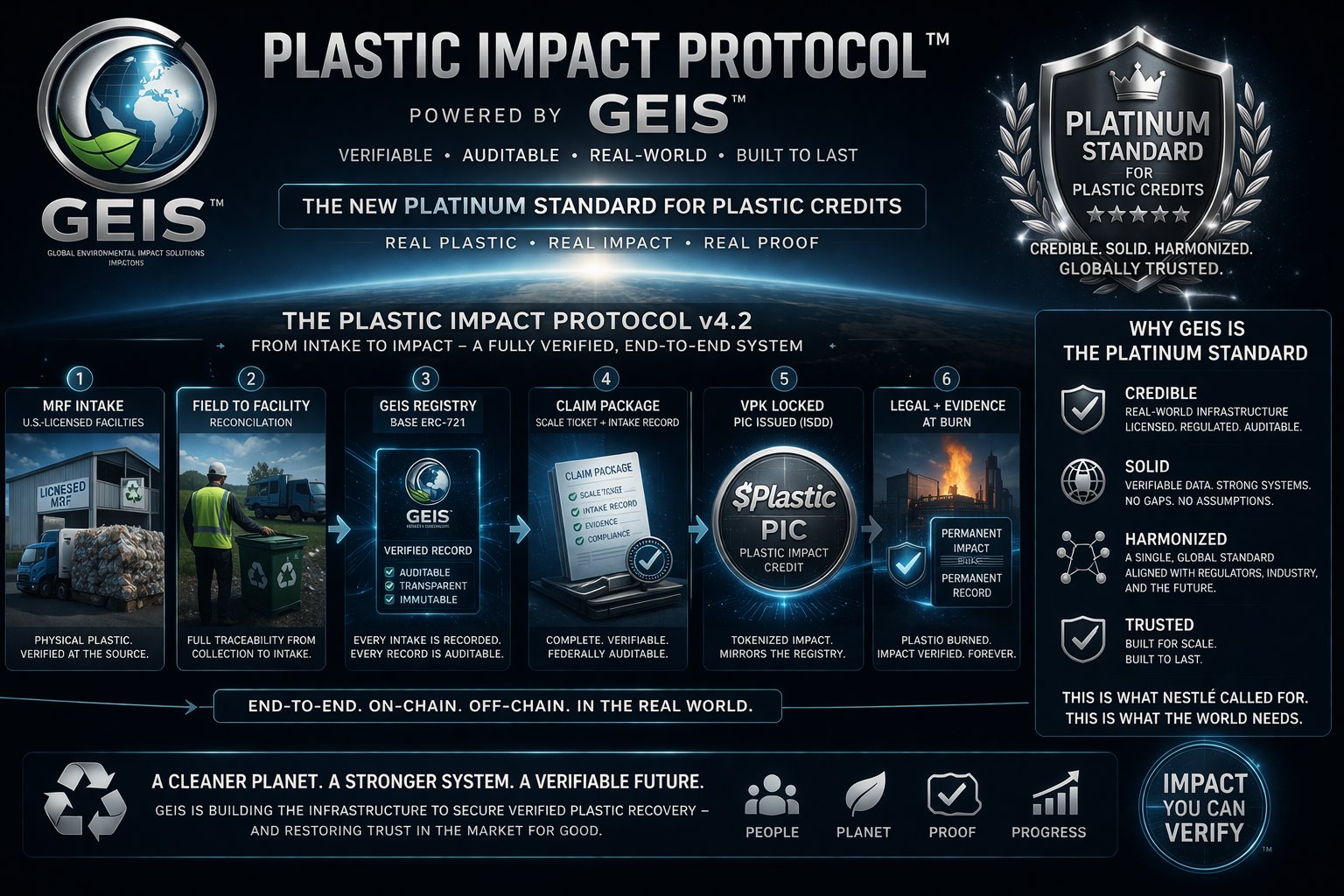
The Plastic Impact Protocol v4.2 is not a policy document or a marketing commitment. It is a governing standard: a published, versioned, publicly auditable rulebook that covers every aspect of how a Plastic Impact Credit is earned, issued, verified, registered, tokenized, and retired — and what a corporate buyer can legally claim when they do so. Every other organization in this market sets its own rules internally. None have published a document of this kind. GEIS has.
PROTOCOL COMPONENTS & STATUS:
Core Program Standard — ACTIVE
Eligibility, credit lifecycle, assurance framework, registry governance, claims rules, community safeguards, and migration pathway. The governing authority for all GEIS activity.
Methodology A: Collection (PIC-C) — ACTIVE
Credits for plastic physically collected from conditions presenting credible mismanagement risk. Every collection event traced to an individual GPS-confirmed participant. Incineration excluded architecturally.
Methodology B: Mechanical Recycling (PIC-MR) — ACTIVE
Credits for plastic entering qualifying mechanical recycling through U.S.-licensed MRFs. Based on verified net eligible input. No advanced recycling or incineration permitted under this methodology.
Reserved Annex C: Advanced Recycling — GATED (Hard Gate)
Zero credits issued until GEIS publishes a formal activation notice with technology-specific environmental methodology. This is the architectural wall against incineration fraud.
Section 9: Registry ID System + Status Codes — ACTIVE
11 record types with hierarchical IDs. 12 controlled status codes. 4 account types. The infrastructure that makes the Registry auditable and the on-chain layer subordinate to it.
Section 10: Individual Participant Records — ACTIVE
13-field individual collection record schema. Field-to-facility reconciliation mandatory. The only individual-level evidence tier in the plastic credit market.
Section 13: Digital Representations — ACTIVE
Registry Supremacy codified. Mint rules. Burn coordination. Freeze propagation. Invalidation. ERC-721 tokens on Base blockchain. Token = derivative, never source of truth.
Section 14: Claims + Display Rules — ACTIVE
Prohibited language per scenario. "Plastic neutral" banned without separate GEIS Claims Guidance. Every display state defined. Closes the greenwashing exposure that leaves every competitor program legally vulnerable.
Hybrid Claim Architecture (new in v4.2) — ACTIVE
Burn Attribution Calculation assigns fractional impact to each buying party at retirement. Evidence Partitioning generates an immutable record per buyer. Three-Tier Claim Package delivered at the moment of burn — the first individually attributed, legally grounded impact claim system in the market.
THREE THINGS GEIS CAN SAY THAT NO OTHER ORGANIZATION IN THIS MARKET CAN SAY
01 — THE ONLY PUBLISHED STANDARD
GEIS is the only plastic credit program with a published, versioned, auditable governing protocol.
Every other organization — Verra, PCX, Plastic Bank, rePurpose Global, CleanHub, Plastiks, Empower, BVRio, Tontoton — sets its own rules internally. None have published a versioned governing standard that a buyer, regulator, investor, or auditor can read, cite, and hold the program accountable to. GEIS has. Published. Versioned. Publicly available at GEISolutions.com. No other organization can make this claim.
02 — THE ONLY U.S.-REGULATED INFRASTRUCTURE
GEIS is the only plastic credit program built on U.S.-licensed, federally regulated infrastructure.
Every plastic credit program on earth — without exception — operates its collection and processing infrastructure in the developing world. Philippines, Indonesia, Cambodia, India, Kenya, Brazil, Haiti, Ghana. GEIS builds through licensed U.S. Materials Recovery Facilities under applicable U.S. federal and state regulation. This is not a geographic preference. It is an integrity architecture: U.S.-licensed facilities generate weight documentation under federal law, subject to regulatory oversight, with chain-of-custody accountability structures that do not exist in any competitor program.
03 — THE ONLY INDIVIDUAL PARTICIPANT RECORD SCHEMA
GEIS is the only plastic credit program with a formal individual participant record schema and proprietary enforcement technology.
Every competitor aggregates at the project or batch level. No competitor can produce a record tied to a specific named individual, GPS-confirmed collection location, exact collected weight, payment status, and custody transfer — all cryptographically time-stamped at the moment of collection, not estimated later. The GEIS dApp generates this record for every participant and enforces its integrity at the moment of data entry. This is the only plastic credit protocol in the world where additionality is evidenced at the individual human level.
THE FEDERAL CONTRACTING FLOOR: A DEMAND CHANNEL NO COMPETITOR CAN ENTER
The plastic credit market has one structural weakness that even a well-designed protocol cannot fix on its own: demand. Every competitor is entirely dependent on voluntary corporate ESG spending — discretionary budgets that contract in economic downturns, disappear when sustainability officers change, and are subject to the greenwashing litigation scrutiny that has only intensified as regulatory pressure has grown.
GEIS is a SAM.gov-registered Service-Disabled Veteran-Owned Small Business. CEO Yerahmeel Ben-Yehudah is a 100% service-disabled veteran. CTO Julian Walle is a 100% service-disabled veteran. Together they hold 75% of GEIS — far exceeding the 51% SDVOSB minimum. This creates access to a federal procurement channel — government agencies that are required, not invited, to consider SDVOSB vendors for their procurement needs — that is structurally independent of voluntary ESG markets.
Federal agencies, defense installations, and government facilities generate plastic waste. Under SDVOSB set-asides, GEIS has access to federal procurement channels that no foreign-founded, developing-world-focused competitor can enter. Zero competitors in plastic crediting hold SDVOSB status. The protocol is what makes the credits credible. The SDVOSB status is what makes the demand floor stable — independent of market cycles, ESG budget fluctuations, or the shifting priorities of corporate sustainability departments.
BUILT WITHOUT EXTERNAL CAPITAL. INFRASTRUCTURE OPERATIONAL.
GEIS did not come to EarthX with a concept or a whitepaper. Every element of the GEIS infrastructure was built before a single dollar of external capital was raised. This is not positioning. It is the record.
Plastic Impact Protocol v4.2 — Published April 2, 2026. Publicly available. Versioned. The governing authority for all GEIS credit issuance, registry management, on-chain representation, and buyer claims. Supersedes v4.1. Two active credit classes: PIC-C (Community Collection) and PIC-MR (Mechanical Recycling). Credit pricing from $350 to $750+ per verified metric tonne — the top of market for each class.
FL-Based MRF Partner — U.S.-licensed, federally regulated Materials Recovery Facility. Full chain-of-custody and federal weight documentation. Formal agreement execution May 4, 2026, Sarasota, Florida.
Treegens Foundation — 12 Nations — Committed subcontractor. Volunteer labor across state chapters and international teams. Individual dApp registration per Protocol v4.2. Dual-impact operation: plastic removal and reforestation in a single field deployment. Paid per tonne upon credit sale.
Independent 3rd-Party Verifier — Confirmed. Identified via MRF partner. 20+ years waste and MRF operations experience. Volume-based compensation prohibited per Protocol v4.2 Section 11.
Commercial Plastic Siding Stream — MOU with Style Craft Inc executed. Contractors diverting plastic siding from landfill to GEIS MRF. PIC-MR pathway. Additional contractor connections active.
Logistics Network + Smart Container Pilot — Florida dumpster network. QR-coded containers deploy post-dApp launch. Community scans, collects, earns via smart contract. First site identified, Sarasota area. Signing May 4, 2026.
GEIS dApp Developer Handoff v4.0 — Complete. Full technical specification and OpenAPI contract. Individual collection tracking, GPS confirmation, weight verification, direct participant payment tied to verified weight, VPK accumulation, on-chain synchronization, and Hybrid Claim Architecture. Active development begins upon funding close.
STATEMENT FROM YERAHMEEL BEN-YEHUDAH, CEO AND FOUNDER:
"I did this research because I wanted to build something that could not be attacked the way carbon credits were attacked. I studied every organization that tried to do this before us. I found sixteen failure modes. Then I built a protocol that closes every single one of them architecturally. Not with a policy. Not with a promise. With structure.
The market is $462 million today and growing at 23.6% per year. But Nestlé won't touch it. Danone backed out. The researchers call it waste colonialism. The investigators found 86% burning and 60% missing auditors. And nobody in the space has published a governing standard. Not one.
We built on U.S. soil. Through U.S.-licensed facilities. Under federal regulation. As a Service-Disabled Veteran-Owned Small Business. With a protocol that any lawyer, regulator, or institutional buyer can read, cite, and hold us accountable to. With a dApp that tracks plastic to the individual human level.
Being accepted to EarthX as an Innovator means the world is ready to see what the Platinum Standard looks like. We are ready to show them."
— Yerahmeel Ben-Yehudah, CEO & Founder, Global Environmental Impact Solutions
RESEARCH SOURCES — THIS ANALYSIS IS DOCUMENTED, NOT CLAIMED:
Break Free From Plastic / GAIA — "Smoke and Mirrors" report, November 2023. Named specific Verra and PCX failures. 83% of projects lacked additionality. 60% of PCX certified records had no third-party auditor.
AFP / SourceMaterial — Investigation of Chip Mong Insee kiln and 4-marketplace analysis, February 2025. 75%+ of credits from incineration or co-processing. Community health impact documented.
Eunomia Research / Fauna & Flora — "Exploring Plastic Credit Schemes," October/November 2024. Of 993 Verra credits issued 2022–2023, only 19% sold by October 2024.
CarbonPlan — "Zombies on the Blockchain," April 2022. Toucan/KlimaDAO zombie credit analysis. BCT/KLIMA token collapse documented.
India CPCB / Down to Earth / CSE — 600,000–700,000 fake certificates = 38x processing capacity of audited recyclers. Rs. 355 crore in regulatory fines. October 2024.
Moon et al. (2024) — "Unpacking Plastic Credits" — waste colonialism academic analysis. Published ScienceDirect, May 2025.
Environmental Investigation Agency — UK PRN/PERN fraud: 10–15% fraudulent certificates, £30–50M in fraudulent annual claims. October 2024.
Valuates Reports / QYResearch — Plastic Credit Market: $462M (2024) to $1.79B (2031) at 23.6% CAGR. July 2025.
BloombergNEF — Plastic Credit Market projected $4.2 billion by 2050.
Nestlé / Danone — Public statements on governing standards quoted directly from official company website and official spokesperson on record. Not paraphrased.
ABOUT GLOBAL ENVIRONMENTAL IMPACT SOLUTIONS (GEIS):
Global Environmental Impact Solutions (GEIS) is the company that built what the plastic credit market has been demanding for years and no organization had produced: a published, versioned, publicly auditable governing standard that closes every documented failure in the market — architecturally, not just on paper.
We are a Service-Disabled Veteran-Owned Small Business. We build exclusively on U.S. soil, through U.S.-licensed, federally regulated infrastructure. We track every kilogram of plastic to the individual human being who collected it. We publish our rules so any buyer, regulator, or attorney can read them, cite them, and hold us accountable.
The plastic credit market is worth $462 million today. Nestlé won't touch it. Danone won't touch it. They've said publicly why: there is no governing standard. There is now.
GEISolutions.com
"Transparency is not our PR strategy. It is our competitive advantage."
GEIS: Governing Eco-Credits with Purpose and Precision
About GEIS (Global Environmental Impact Solutions LLC)
GEIS (Global Environmental Impact Solutions LLC) is the company that built what the plastic credit market has been demanding for years and no organization had produced: a published, versioned, publicly auditable governing standard that closes every documented failure in the market — architecturally, not just on paper. We are a Service-Disabled Veteran-Owned Small Business. We build exclusively on U.S. soil, through U.S.-licensed, federally regulated infrastructure. We track every kilogram of plastic to the individual human being who collected it. We publish our rules so any buyer, regulator, or attorney can read them, cite them, and hold us accountable. The plastic credit market is worth $462 million today. Nestlé won't touch it. Danone won't touch it. They've said publicly why: there is no governing standard. There is a Platinum Standard now, and it's called GEIS. GEISolutions.com
Press Inquiries
Yerahmeel Ben-Yehudah
CEO & Founder
Global Environmental Impact Solutions, LLC
Contact [at] GEISolutions.com
https://www.GEISolutions.com
DISCLAIMER: All market failure data cited in this release is sourced from published investigations, peer-reviewed research, regulatory audits, and public statements. Sources are listed in the Research Sources section of this document. Protocol v4.2 is publicly available at GEISolutions.com. EarthX E-Capital Summit statistics reflect published conference figures. This release does not constitute an offer to sell or solicitation of an offer to buy any securities.
