Austin, Feb. 09, 2026 (GLOBE NEWSWIRE) -- Solar Panel Cleaning Market Size & Growth Insights:
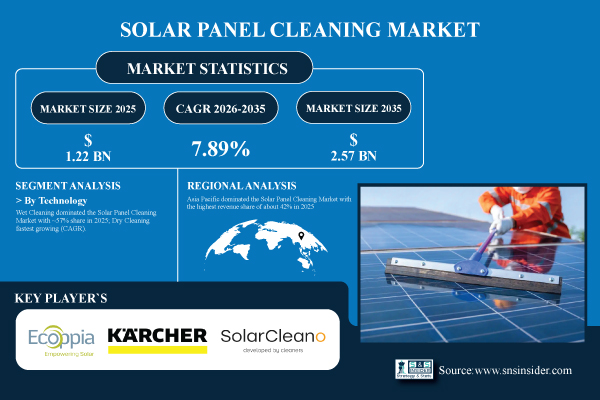
According to the SNS Insider, “The Solar Panel Cleaning Market was valued at USD 1.22 billion in 2025 and is expected to reach USD 2.57 billion by 2035, growing at a CAGR of 7.89% over 2026-2035.”
Rapid Solar Capacity Expansion to Propel Market Growth Globally
Regular solar panel cleaning is becoming more and more necessary to guarantee energy output and return on investment as a result of the notable increase in solar power installations across residential, commercial, and utility-scale sectors. Pollution, dust, sand, and bird droppings will significantly reduce the panels' efficiency, which will impact electricity production and income. As part of preventive maintenance, operators are now more concerned with cleaning in order to meet target fabrications and avoid output drops. The cleaning process is crucial for asset optimization since exposure to the outside environment, particularly in large-scale solar farms, increases soiling losses to the plant.
Get a Sample Report of Solar Panel Cleaning Market Forecast @ https://www.snsinsider.com/sample-request/9706
Leading Market Players with their Product Listed in this Report are:
- Ecoppia
- Kärcher
- SolarCleano
- SunBrush mobil GmbH
- Serbot AG
- IPC Eagle (Tennant Company)
- Heliotex LLC
- Nomadd
- BladeRanger
- F-Clean
- Boson Robotics Ltd.
- Carmanah Technologies Corp
- Clean Solar Solutions Ltd.
- Parish Maintenance Supply
- Saint-Gobain Surface Conditioning
- Sharp Corporation
- Indisolar Products Private Limited
- Solar Cleaning Machinery
- Taypro
- Greenleap Robotics
Solar Panel Cleaning Market Report Scope:
| Report Attributes | Details |
| Market Size in 2025E | USD 1.22 Billion |
| Market Size by 2035 | USD 2.57 Billion |
| CAGR | CAGR of 7.89% From 2026 to 2035 |
| Report Scope & Coverage | Market Size, Segments Analysis, Competitive Landscape, Regional Analysis, DROC & SWOT Analysis, Forecast Outlook |
| Key Segmentation | • By Process (Semi-Automated, Automated, Water Brushes, Electrostatic, Automated Robotic, Others) • By Technology (Wet Cleaning, Dry Cleaning) • By Application (Residential, Commercial, Industrial and Utility) • By Mode of Operation (Manual, Autonomous) |
Purchase Single User PDF of Solar Panel Cleaning Market Report (20% Discount) @ https://www.snsinsider.com/checkout/9706
Key Segmentation Analysis:
By Technology
Wet Cleaning dominated the Solar Panel Cleaning Market with ~57% share in 2025 as it efficiently cleans dust, dirt, pollens and bird droppings, and provides maximum efficiency of solar panels. Dry cleaning segment is expected to grow at the fastest CAGR from 2026-2035 owing to water-free cleaning, reduced operational expenses, and dry cleaning is the best cleaning option in arid regions where water scarcity is major focus.
By Application
Industrial and Utility dominated the Solar Panel Cleaning Market with ~49% share in 2025 as solar farms are large in area, and they need regular cleaning to maintain high energy production. Commercial segment is expected to grow at the fastest CAGR from 2026-2035 due to the increasing rooftop solar installations on offices, malls, and commercial buildings.
By Process
Manual dominated the Solar Panel Cleaning Market with ~51% share in 2025 due its cost efficiency and easy applicability in small-medium installations. Automated (Robotic) segment is expected to grow at the fastest CAGR from 2026-2035 as there is an increase in the adoption of labor-saving, high-efficiency technologies for cleaning.
By Mode of Operation
Autonomous dominated the Solar Panel Cleaning Market with ~46% share in 2025 and is also expected to grow at the fastest CAGR from 2026-2035 due to its ability to perform consistent, high-quality cleaning with minimal human intervention, reducing labor costs and improving operational efficiency.
Regional Insights:
Asia Pacific dominated the Solar Panel Cleaning Market with the highest revenue share of about 42% in 2025 due solar energy capacity was growing quickly, especially in China, India, and Japan.
Due to the widespread and massive usage of solar energy in the residential, commercial, and utility sectors, North America commands a substantial share of the solar panel cleaning market. large-scale solar farm investments, strict energy efficiency regulations, and growing use of robotic and automated cleaning technology.
High Initial Investment Costs is Limiting Market Expansion Globally
The adoption and utilization of automated and robotic systems for small-scale or domestic applications are restricted by their high initial cost. For modern equipment, specialized hardware, installation, and occasionally system integration constitutes significant capital expenditures. Many operators continue to rely on manual or sporadic cleaning, despite the long-term efficacy benefits, because of cost considerations. For smaller solar asset owners who cannot see immediate financial benefits, automation investments can be hard to justify. For complicated systems, the expense of upkeep and repairs adds to the cost of ownership.
Do you have any specific queries or need any customized research on Solar Panel Cleaning Market? Submit your inquiry here @ https://www.snsinsider.com/enquiry/9706
Recent Developments:
- 2025: Ecoppia sustained global deployment of its autonomous robotic cleaning systems across utility-scale solar projects, reinforcing its role in optimizing photovoltaic performance through water-free operations.
- 2025: SolarCleano achieved operations in over 100 countries, highlighting rapid global adoption of its robotic solar panel cleaning solutions to improve PV efficiency and renewable asset maintenance.
Exclusive Sections of the Solar Panel Cleaning Market Report (The USPs):
- EFFICIENCY LOSS DUE TO PANEL SOILING – helps you quantify average monthly efficiency loss caused by dust and dirt accumulation, enabling accurate assessment of revenue leakage and performance degradation.
- ENERGY YIELD RECOVERY POST CLEANING – helps you evaluate the effectiveness of cleaning interventions by measuring the percentage of energy output restored after cleaning activities.
- DUST DEPOSITION RATE BY CLIMATE TYPE – helps you identify high-risk geographies by analyzing dust accumulation rates across arid, semi-arid, urban, and coastal environments.
- SEASONAL VARIABILITY IN SOILING LOSSES – helps you understand how seasonal factors such as monsoons, dry spells, and wind patterns impact solar panel performance throughout the year.
- SOILING-DRIVEN PERFORMANCE RISK PROFILING – helps you prioritize maintenance strategies by linking soiling intensity directly to operational and energy yield risks across installations.
About Us:
SNS Insider is one of the leading market research and consulting agencies that dominates the market research industry globally. Our company's aim is to give clients the knowledge they require in order to function in changing circumstances. In order to give you current, accurate market data, consumer insights, and opinions so that you can make decisions with confidence, we employ a variety of techniques, including surveys, video talks, and focus groups around the world.
Read Other Trending Research Reports:
AI in Video Surveillance Market
Application Specific Integrated Circuit Market
