Dublin, Jan. 29, 2026 (GLOBE NEWSWIRE) -- The "Bangladesh B2C Ecommerce Market Size & Forecast by Value and Volume Across 80+ KPIs - Databook Q4 2025 Update" report has been added to ResearchAndMarkets.com's offering.
The ecommerce market in Bangladesh is expected to grow by 8.3% annually, reaching US$7.41 billion by 2025. The ecommerce market in the country has experienced robust growth during 2020-2024, achieving a CAGR of 11.2%. This upward trajectory is expected to continue, with the market forecast to grow at a CAGR of 6.8% from 2025 to 2029. By the end of 2029, the ecommerce market is projected to expand from its 2024 value of US$6.84 billion to approximately US$9.65 billion.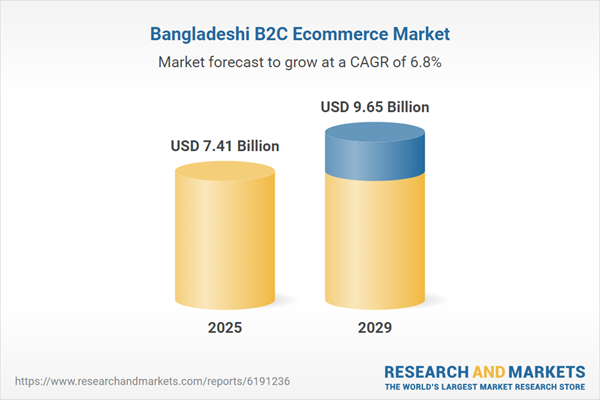
Over the next 2-4 years, the market dynamic in Bangladesh is likely to shift toward stronger consolidation and platform convergence. The leading marketplaces will invest heavily in logistics, payment integration and regional expansion (outside Dhaka) while smaller niche players will either find differentiated segments or become acquisition targets.
The competitive intensity will intensify, with pricing, service speed and payment convenience becoming key battlegrounds. Given the low share of total retail currently online, the opportunity for growth remains, yet there will be pressure on margins and a need for operational efficiency. Firms that define a clear value proposition (logistics, vertical specialisation, or payments ecosystem) will likely gain share; those that don't may struggle as competition rises.
Current State of the Market
The e-commerce ecosystem in Bangladesh has moved from an early stage to meaningful scale. Industry commentary places the sector's value at around US$6.9 billion in 2023, rising toward US$7.5 billion in 2024. Yet online retail still accounts for only 3-5 percent of total retail in the country, indicating that the market remains under-penetrated. Competition is increasing across product categories, logistics and payments, and local players are evolving operationally. The landscape remains fragmented with strong local incumbents, international entrants and specialized niche platforms all vying for share.
Key Players and New Entrants
Major players include Daraz (owned by Alibaba Group), which continues to lead in terms of reach and infrastructure in Bangladesh. Others, such as Chaldal (grocery) and Pickaboo (electronics & general goods), are recognised in top-site rankings. On the new-entrants side, platforms targeting niche categories, social-commerce and B2B2C models are emerging; for example, the startup ecosystem ranks many e-commerce & retail ventures among Bangladesh's top startups in 2025. The competitive intensity is rising as both global and local players accelerate investments in logistics, payments and digital marketing to differentiate.
Key Trends and Drivers
Increasing mobile and internet connectivity, enabling e-commerce expansion
- In Bangladesh, e-commerce is increasingly supported by mobile device usage and improving internet connectivity, which enables more consumers to use online channels for shopping and services. For example, recent commentary points to mobile-first design and app usage becoming standard for Bangladeshi e-commerce players.
- Smartphone penetration and mobile internet access continue to rise, creating a broader base of potential online shoppers. Infrastructure improvements and platform-digital readiness (e.g., multi-vendor systems, improved site/app performance) are helping online businesses scale. The COVID-19 period accelerated the adoption of digital commerce, creating lasting behavioural change in Bangladesh.
- The number of online shoppers in Bangladesh is likely to grow significantly, with deeper penetration into second-tier cities and rural markets. Mobile-first and app-centric platforms will become the standard mode of operation, so companies will need to optimise for mobile UX, connectivity constraints, and localisation.
- Infrastructure limitations (e.g., slower internet in remote areas) will still be a constraint, so firms that build robust mobile-light versions and optimise for lower connectivity will have an advantage. The rate of growth may slow as connectivity saturates in urban zones, but rural and "next-100 million" users will keep expansion underway.
Growth of digital payments and shifting payment methods
- Bangladesh's e-commerce market is showing a clear transition away from reliance on cash-on-delivery and other offline methods, with increasing uptake of digital payments, mobile wallets, QR-based transactions, and fintech-led solutions. Mobile-wallet providers like bKash are frequently highlighted as central to expanding the country's digital payment infrastructure.
- Growth in fintech and mobile financial services is expanding the payment options available to consumers, including in rural areas previously poorly served by banks. Policy initiatives and banking sector developments (e.g., QR code payments, the interoperable payments roadmap) are driving the ecosystem toward greater digital flows. For e-commerce platforms, digital payments reduce some of the friction and costs associated with cash transactions (such as COD returns and courier risk), making them more attractive.
Rise of social commerce and platform-driven shopping behaviours
- Social media and digitally-native platforms in Bangladesh are increasingly influencing e-commerce, both as discovery channels and as transaction points (social commerce). Recent qualitative studies of Bangladeshi buyers and sellers indicate that social media platforms are central to online commerce. For example, one study reports that social commerce is reshaping behaviours in Bangladesh.
- Social commerce will increasingly blur the line between entertainment and shopping; in Bangladesh, platforms that integrate social features (reviews, influencer-led sales, live-streams) will gain share. Traditional e-commerce marketplaces may need to adapt by integrating social-commerce elements (chat, community, peer reviews) to remain competitive.
Logistics, fulfillment and geographical expansion beyond urban centres
- In Bangladesh, as the e-commerce market moves from urban centres toward less-served regions, logistics and fulfilment capability (last-mile delivery, regional warehousing, integrated operations) are becoming critical. Sources note that Bangladeshi e-commerce providers increasingly emphasise multi-vendor marketplace models and fulfilment expectations (faster delivery).
- The next increment of online users in Bangladesh resides outside Dhaka and major cities reaching them requires better delivery infrastructure, regional hubs and tailored operations. Consumer expectations globally (and increasingly locally) are shifting toward faster fulfilment, greater delivery visibility, and better returns management even in Bangladesh, this is relevant. Competitive pressure among marketplaces and digital retail operators in Bangladesh is increasing the need for operational differentiation via logistics and service.
- E-commerce firms that build efficient regional fulfilment networks (smaller cities, semi-urban & rural) will unlock significant growth; failure to do so will constrain expansion. Logistics partner ecosystems (local couriers, micro-fulfilment centres, rider networks) will proliferate in Bangladesh; operational excellence in the last mile will become a competitive advantage.
- Cost pressures (fuel, returns, settlement) will challenge profitability; platforms will need to balance speed, coverage and cost. As geography expands, returns, warranty, and reverse logistics will become increasingly important, especially given Bangladesh's population density and infrastructure constraints.
Key Attributes:
| Report Attribute | Details |
| No. of Pages | 110 |
| Forecast Period | 2025 - 2029 |
| Estimated Market Value (USD) in 2025 | $7.41 Billion |
| Forecasted Market Value (USD) by 2029 | $9.65 Billion |
| Compound Annual Growth Rate | 6.8% |
| Regions Covered | Bangladesh |
Report Scope
Bangladesh B2C Ecommerce Market Size and Growth Dynamics
- Gross Merchandise Value
- Gross Merchandise Volume
- Average Value per Transaction
Bangladesh Social Commerce Market Size and Growth Dynamics
- Gross Merchandise Value
- Gross Merchandise Volume
- Average Value per Transaction
Bangladesh Quick Commerce Market Size and Growth Dynamics
- Gross Merchandise Value
- Gross Merchandise Volume
- Average Value per Transaction
Bangladesh B2C Ecommerce Market Segmentation by Ecommerce Vertical
- Retail Shopping
- Travel & Hospitality
- Online Food Service
- Media & Entertainment
- Healthcare & Wellness
- Technology Products & Services
- Other
Bangladesh B2C Ecommerce Market Segmentation by Retail Shopping Category
- Clothing, Footwear & Accessories
- Health, Beauty & Personal Care
- Food & Beverage
- Appliances & Electronics
- Home Improvement
- Books, Music & Video
- Toys & Hobby
- Auto Parts & Accessories
- Other
Bangladesh B2C Ecommerce Market Segmentation by Retail Shopping Sales Channel
- Platform-to-Consumer
- Direct-to-Consumer
- Consumer-to-Consumer
Bangladesh B2C Ecommerce Market Segmentation by Travel & Hospitality Category
- Air Travel
- Train & Bus
- Taxi & Ride-Hailing
- Hotels & Resorts
- Other
Bangladesh B2C Ecommerce Market Segmentation by Travel and Hospitality Sales Channel
- Air Travel- Aggregator App
- Air Travel- Direct-to-Consumer
- Train & Bus- Aggregator App
- Train & Bus- Direct-to-Consumer
- Taxi & Ride-Hailing- Aggregator App
- Taxi & Ride-Hailing- Direct-to-Consumer
- Hotels & Resorts- Aggregator App
- Hotels & Resorts- Direct-to-Consumer
- Other- Aggregator App
- Other- Direct-to-Consumer
Bangladesh B2C Ecommerce Market Segmentation by Online Food Service Sales Channel
- Aggregator App
- Direct-to-Consumer
Bangladesh B2C Ecommerce Market Segmentation by Media & Entertainment Sales Channel
- Streaming Services
- Movies & Events
- Theme Parks & Gaming
- Other
Bangladesh B2C Ecommerce Market Segmentation by Engagement Model
- Website-Based
- Live Streaming
Bangladesh B2C Ecommerce Market Segmentation by Location
- Cross-Border
- Domestic
Bangladesh B2C Ecommerce Market Segmentation by Device
- Mobile
- Desktop
Bangladesh B2C Ecommerce Market Segmentation by Operating System
- iOS / macOS
- Android
- Other Operating Systems
Bangladesh B2C Ecommerce Market Segmentation by City Tier
- Tier 1
- Tier 2
- Tier 3
Bangladesh B2C Ecommerce Market Segmentation by Payment Instrument
- Credit Card
- Debit Card
- Bank Transfer
- Prepaid Card
- Digital & Mobile Wallet
- Other Digital Payment
- Cash
Bangladesh B2C Ecommerce Consumer Demographics & Behaviour
- Market Share by Age Group
- Market Share by Income Level
- Market Share by Gender
Bangladesh B2C Ecommerce User Statistics & Ratios
- Internet Users
- Ecommerce Users
- Social Media Users
- Smartphone Penetration
- Banked Population
- Ecommerce Per Capita
- GDP Per Capita
- Ecommerce as % of GDP
- Cart Abandonment Rate
- Product Return Rate
For more information about this report visit https://www.researchandmarkets.com/r/1r2vfp
About ResearchAndMarkets.com
ResearchAndMarkets.com is the world's leading source for international market research reports and market data. We provide you with the latest data on international and regional markets, key industries, the top companies, new products and the latest trends.
Attachment
