Dublin, Jan. 29, 2026 (GLOBE NEWSWIRE) -- The "Canada B2C Ecommerce Market Size & Forecast by Value and Volume Across 80+ KPIs - Databook Q4 2025 Update" report has been added to ResearchAndMarkets.com's offering.
The ecommerce market in Canada is expected to grow by 9.6% annually, reaching US$89.27 billion by 2025. The ecommerce market in the country has experienced robust growth during 2020-2024, achieving a CAGR of 11.5%. This upward trajectory is expected to continue, with the market forecast to grow at a CAGR of 7.5% from 2025 to 2029. By the end of 2029, the ecommerce market is projected to expand from its 2024 value of US$81.47 billion to approximately US$119.16 billion.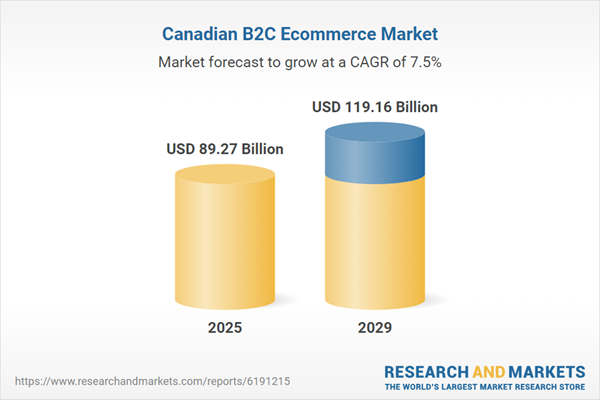
Competitive intensity will increase as marketplaces scale and cross-border players capture share in discretionary categories. Omnichannel retailers are expected to deepen store-based fulfillment, improving speed and lowering delivery costs. Retail media networks operated by large Canadian retailers will become stronger competitive levers. Over the next 2-4 years, differentiation will shift toward logistics density, category breadth, and platform monetisation rather than price alone.
Current State of the Market
Canada's e-commerce landscape is shaped by a mix of international platforms, national retailers, and sector-focused digital channels. Penetration is steady, but competition is concentrated around logistics efficiency, marketplace scale, and retail media capabilities. Large omnichannel retailers such as Loblaw, Canadian Tire, and Walmart Canada continue integrating stores into last-mile networks, reducing reliance on centralized fulfillment. Meanwhile, consumer expectations for faster delivery and broader assortment are intensifying competitive pressure between pure-play platforms and traditional retailers.
Key Players and New Entrants
Amazon Canada remains the largest online retailer, supported by its expanded fulfillment infrastructure and Prime delivery services. Walmart Canada continues to invest in nationwide pickup and marketplace expansion. Among national retailers, Loblaw, Best Buy Canada, and Canadian Tire are strengthening their integrations with the marketplace and loyalty programs. In vertical categories, Sephora Canada, Sport Chek, and IKEA Canada remain key online players.
New entrants include global D2C brands scaling cross-border shipping to Canada, such as Shein and Temu and specialized U.S. retailers that have added Canadian checkout and duty-paid shipping options. Domestic small-business-led digital storefronts are also growing through Shopify's ecosystem.
Expansion of Omnichannel Retail Integration Accelerates
- Large Canadian retailers are accelerating omnichannel integration as store networks regain importance. Companies such as Canadian Tire, Loblaw, Hudson's Bay, and Indigo have expanded services like ship-from-store, same-day pickup, and in-store returns for online orders. Loblaw's 2024 investor updates highlight the continued rollout of integrated e-commerce store operations via PC Express and store-based fulfillment.
- Rising cost pressures are pushing retailers to leverage stores as fulfillment assets rather than expand warehouse footprints. Canadian consumers have returned to physical stores post-pandemic but continue to research and transact online, pushing retailers to merge digital and physical journeys. Logistics constraints, including long-haul transport distances and carrier surcharges, make local fulfilment more efficient.
- More retailers will convert stores into micro-fulfilment hubs and expand pickup-forward formats. Marketplace players like Amazon Canada and Walmart Canada will deepen partnerships with local businesses to expand last-mile reach. Omnichannel will become the default operating model, reducing the distinction between online and offline retail.
Growth of Domestic Marketplaces and Brand-Owned Platforms Intensifies
- Canada is seeing growth in domestic marketplaces and direct-to-consumer (D2C) channels. Loblaw Marketplace, Canadian Tire Marketplace, and Best Buy Canada Marketplace have expanded seller categories in 2023-2024. Globally recognised brands operating in Canada, such as Lululemon and Canada Goose, continue to strengthen their D2C online platforms and loyalty ecosystems.
- Retailers are seeking to diversify revenue streams through third-party seller commissions without holding inventory. Increased advertising opportunities on owned platforms provide additional income streams, similar to U.S. retail media trends. Brands want more control over pricing and data, especially as paid social and search ROI fluctuates.
- Marketplace competition will rise between Amazon, Walmart, and domestic retailer-led platforms. More Canadian brands will move toward hybrid marketplace-plus-D2C models. Retail media will grow, resulting in greater monetisation of traffic on Canadian e-commerce sites.
Payment Modernisation and Adoption of Real-Time Payments Gains Momentum
- Payments modernization is accelerating through Interact e-Transfer's expanded features, bank-led digital wallet growth, and anticipation of Canada's Real-Time Rail (RTR) system, expected to roll out under Payments Canada's modernization program. Retailers, including Shopify merchants, have expanded support for real-time and low-fee payment methods.
- Consumers are increasingly choosing lower-fee, faster payment methods amid rising living costs. Retailers want to reduce card processing fees in a market where discussions about interchange have been active. The regulatory and banking sector push for payments modernization is introducing new rails and security standards.
- RTR adoption will shift some e-commerce payments away from traditional cards toward instant account-to-account methods. Higher usage of Interac-based flows will support faster refunds and payouts, improving consumer experience. Retailers may reconfigure checkout flows to prioritise lower-cost payment instruments.
Cross-Border and U.S.-Linked Purchasing Rises
- Canadians are increasingly purchasing from U.S. and international retailers due to broader assortment, favourable price differences, and aggressive shipping programs. U.S. retailers like Target, Nike, and Shein have increased their shipping presence to Canada. The continued strength of Amazon's U.S.-to-Canada shipping pipeline is influencing consumer expectations for assortment breadth.
- Many U.S. retailers integrate Canadian shipping options even without physical presence, widening category availability. Currency fluctuations, promotional pricing, and awareness of duty thresholds drive consumers toward cross-border deals. Canadian consumers have become comfortable with longer shipping times when the price advantages justify them.
- Cross-border activity will continue to rise unless regulatory changes raise duty thresholds or impose new requirements. Canadian retailers will respond with broader online assortments and more aggressive price-matching strategies. Logistics providers may introduce more cross-border consolidation hubs to reduce per-parcel cost.
Key Attributes:
| Report Attribute | Details |
| No. of Pages | 110 |
| Forecast Period | 2025 - 2029 |
| Estimated Market Value (USD) in 2025 | $89.27 Billion |
| Forecasted Market Value (USD) by 2029 | $119.16 Billion |
| Compound Annual Growth Rate | 7.5% |
| Regions Covered | Canada |
Report Scope
Canada B2C Ecommerce Market Size and Growth Dynamics
- Gross Merchandise Value
- Gross Merchandise Volume
- Average Value per Transaction
Canada Social Commerce Market Size and Growth Dynamics
- Gross Merchandise Value
- Gross Merchandise Volume
- Average Value per Transaction
Canada Quick Commerce Market Size and Growth Dynamics
- Gross Merchandise Value
- Gross Merchandise Volume
- Average Value per Transaction
Canada B2C Ecommerce Market Segmentation by Ecommerce Vertical
- Retail Shopping
- Travel & Hospitality
- Online Food Service
- Media & Entertainment
- Healthcare & Wellness
- Technology Products & Services
- Other
Canada B2C Ecommerce Market Segmentation by Retail Shopping Category
- Clothing, Footwear & Accessories
- Health, Beauty & Personal Care
- Food & Beverage
- Appliances & Electronics
- Home Improvement
- Books, Music & Video
- Toys & Hobby
- Auto Parts & Accessories
- Other
Canada B2C Ecommerce Market Segmentation by Retail Shopping Sales Channel
- Platform-to-Consumer
- Direct-to-Consumer
- Consumer-to-Consumer
Canada B2C Ecommerce Market Segmentation by Travel & Hospitality Category
- Air Travel
- Train & Bus
- Taxi & Ride-Hailing
- Hotels & Resorts
- Other
Canada B2C Ecommerce Market Segmentation by Travel and Hospitality Sales Channel
- Air Travel- Aggregator App
- Air Travel- Direct-to-Consumer
- Train & Bus- Aggregator App
- Train & Bus- Direct-to-Consumer
- Taxi & Ride-Hailing- Aggregator App
- Taxi & Ride-Hailing- Direct-to-Consumer
- Hotels & Resorts- Aggregator App
- Hotels & Resorts- Direct-to-Consumer
- Other- Aggregator App
- Other- Direct-to-Consumer
Canada B2C Ecommerce Market Segmentation by Online Food Service Sales Channel
- Aggregator App
- Direct-to-Consumer
Canada B2C Ecommerce Market Segmentation by Media & Entertainment Sales Channel
- Streaming Services
- Movies & Events
- Theme Parks & Gaming
- Other
Canada B2C Ecommerce Market Segmentation by Engagement Model
- Website-Based
- Live Streaming
Canada B2C Ecommerce Market Segmentation by Location
- Cross-Border
- Domestic
Canada B2C Ecommerce Market Segmentation by Device
- Mobile
- Desktop
Canada B2C Ecommerce Market Segmentation by Operating System
- iOS / macOS
- Android
- Other Operating Systems
Canada B2C Ecommerce Market Segmentation by City Tier
- Tier 1
- Tier 2
- Tier 3
Canada B2C Ecommerce Market Segmentation by Payment Instrument
- Credit Card
- Debit Card
- Bank Transfer
- Prepaid Card
- Digital & Mobile Wallet
- Other Digital Payment
- Cash
Canada B2C Ecommerce Consumer Demographics & Behaviour
- Market Share by Age Group
- Market Share by Income Level
- Market Share by Gender
Canada B2C Ecommerce User Statistics & Ratios
- Internet Users
- Ecommerce Users
- Social Media Users
- Smartphone Penetration
- Banked Population
- Ecommerce Per Capita
- GDP Per Capita
- Ecommerce as % of GDP
- Cart Abandonment Rate
- Product Retun Rate
Canada B2C Ecommerce Operational Metrics by Ecommerce Segment
- Gross Merchandise Value by Segment
Canada B2C Ecommerce Operational Metrics by Retail Shopping Category
- Gross Merchandise Value by Category
Canada B2C Ecommerce Operational Metrics by Sales Channel
- Gross Merchandise Value by Channel
Canada B2C Ecommerce Operational Metrics by Location
- Gross Merchandise Value by Location
Canada B2C Ecommerce Operational Metrics by Device
- Gross Merchandise Value by Device
Canada B2C Ecommerce Operational Metrics by Operating System
- Gross Merchandise Value by Operating System
Canada B2C Ecommerce Operational Metrics by City Tier
- Gross Merchandise Value by City Tier
Canada B2C Ecommerce Operational Metrics by Payment Instrument
- Gross Merchandise Value by Payment Instrument
For more information about this report visit https://www.researchandmarkets.com/r/i5i9ow
About ResearchAndMarkets.com
ResearchAndMarkets.com is the world's leading source for international market research reports and market data. We provide you with the latest data on international and regional markets, key industries, the top companies, new products and the latest trends.
Attachment
