Dublin, Jan. 19, 2026 (GLOBE NEWSWIRE) -- The "Boutique Hotels Market - Global Forecast 2026-2032" has been added to ResearchAndMarkets.com's offering.
The boutique hotels market is witnessing sustained growth driven by evolving guest preferences, innovative operations, and a heightened focus on personalized guest experiences coupled with supply chain resilience. This dynamic environment presents senior leaders with challenges related to changing traveler demands, cost pressures, and competitive landscapes, requiring strategic navigation to ensure long-term value and operational flexibility.
Market Snapshot: Boutique Hotels Market Size & Growth
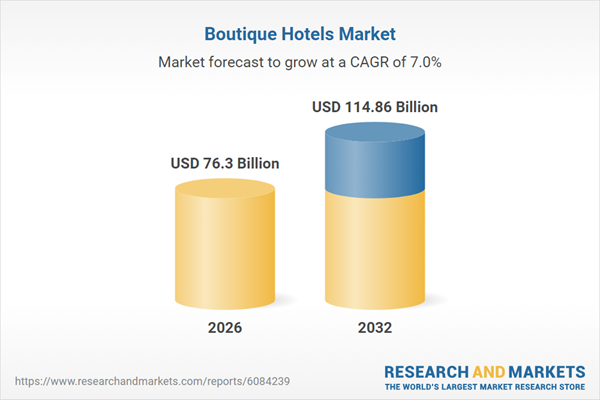
The Boutique Hotels Market expanded from USD 71.56 billion in 2025 to USD 76.30 billion in 2026. The market is projected to continue its growth trajectory at a compound annual growth rate of 6.99%, reaching USD 114.86 billion by 2032.
Scope & Segmentation
- Hotel Types:
- Classic Boutique Hotels
- Luxury Boutique Hotels
- Themed Boutique Hotels
- Property Sizes:
- Large Boutique Hotels
- Medium Boutique Hotels
- Small Boutique Hotels
- Traveler Origin:
- Domestic-focused
- International-focused
- Booking Channels:
- Offline Booking: legacy, group, walk-in
- Online Booking: direct, metasearch, CRM-integrated
- Key Regions:
- Americas: urban and secondary cities
- Europe/Middle East/Africa: heritage-led, regulatory-focused
- Asia-Pacific: rapid urbanization, domestic travel growth
- Technology Enablers:
- Digital distribution
- Contactless services
- Guest personalization platforms
- Direct booking engines
- Loyalty integration
- Operational Pillars:
- Design partnerships
- Procurement strategies
- Local experience curation
- Sustainability initiatives
Strategic insights enable executives to prioritize investments and adjust operating models to align with resilient, guest-centric offerings. Decision-makers can also find actionable strategies within this report for adapting to regulatory changes, managing supply chain disruptions, and evolving traveler expectations.
Key Takeaways from This Report
- Boutique hotel operators achieve differentiation through authentic local storytelling, design-led programming, and curated partnerships with creative and culinary providers.
- Strong investment in digital experiences-such as frictionless booking and hyper-personalization-coupled with integrated communication, is vital to meeting guest expectations while retaining brand-defining human touch.
- Operators increasingly favor adaptive reuse and compact, experiential design models over traditional builds, accelerating market entry and enhancing brand distinction.
- Labor constraints and increasing service costs have led to targeted automation of routine functions, along with cross-skilling and staff training to maintain quality experiences.
- Sustainability and social impact initiatives significantly influence brand value and guest decision-making, becoming central to strategic and procurement decisions.
- Collaboration among revenue, procurement, and design teams, supported by reliable data, drives adaptive decision-making encompassing project planning, capital allocation, and guest service innovation.
Key Attributes
| Report Attribute | Details |
| No. of Pages | 185 |
| Forecast Period | 2026-2032 |
| Estimated Market Value (USD) in 2026 | $76.3 Billion |
| Forecasted Market Value (USD) by 2032 | $114.86 Billion |
| Compound Annual Growth Rate | 6.9% |
| Regions Covered | Global |
Key Topics Covered
1. Preface
1.1. Objectives of the Study
1.2. Market Definition
1.3. Market Segmentation & Coverage
1.4. Years Considered for the Study
1.5. Currency Considered for the Study
1.6. Language Considered for the Study
1.7. Key Stakeholders
2. Research Methodology
2.1. Introduction
2.2. Research Design
2.2.1. Primary Research
2.2.2. Secondary Research
2.3. Research Framework
2.3.1. Qualitative Analysis
2.3.2. Quantitative Analysis
2.4. Market Size Estimation
2.4.1. Top-Down Approach
2.4.2. Bottom-Up Approach
2.5. Data Triangulation
2.6. Research Outcomes
2.7. Research Assumptions
2.8. Research Limitations
3. Executive Summary
3.1. Introduction
3.2. CXO Perspective
3.3. Market Size & Growth Trends
3.4. Market Share Analysis, 2025
3.5. FPNV Positioning Matrix, 2025
3.6. New Revenue Opportunities
3.7. Next-Generation Business Models
3.8. Industry Roadmap
4. Market Overview
4.1. Introduction
4.2. Industry Ecosystem & Value Chain Analysis
4.2.1. Supply-Side Analysis
4.2.2. Demand-Side Analysis
4.2.3. Stakeholder Analysis
4.3. Porter's Five Forces Analysis
4.4. PESTLE Analysis
4.5. Market Outlook
4.5.1. Near-Term Market Outlook (0-2 Years)
4.5.2. Medium-Term Market Outlook (3-5 Years)
4.5.3. Long-Term Market Outlook (5-10 Years)
4.6. Go-to-Market Strategy
5. Market Insights
5.1. Consumer Insights & End-User Perspective
5.2. Consumer Experience Benchmarking
5.3. Opportunity Mapping
5.4. Distribution Channel Analysis
5.5. Pricing Trend Analysis
5.6. Regulatory Compliance & Standards Framework
5.7. ESG & Sustainability Analysis
5.8. Disruption & Risk Scenarios
5.9. Return on Investment & Cost-Benefit Analysis
6. Cumulative Impact of United States Tariffs 2025
7. Cumulative Impact of Artificial Intelligence 2025
8. Boutique Hotels Market, by Hotel Type
8.1. Classic Boutique Hotels
8.2. Luxury Boutique Hotels
8.3. Themed Boutique Hotels
9. Boutique Hotels Market, by Size
9.1. Large Boutique Hotels
9.2. Medium Boutique Hotels
9.3. Small Boutique Hotels
10. Boutique Hotels Market, by Tourist Type
10.1. Domestic
10.2. International
11. Boutique Hotels Market, by Booking Type
11.1. Offline Booking
11.2. Online Booking
12. Boutique Hotels Market, by Region
12.1. Americas
12.1.1. North America
12.1.2. Latin America
12.2. Europe, Middle East & Africa
12.2.1. Europe
12.2.2. Middle East
12.2.3. Africa
12.3. Asia-Pacific
13. Boutique Hotels Market, by Group
13.1. ASEAN
13.2. GCC
13.3. European Union
13.4. BRICS
13.5. G7
13.6. NATO
14. Boutique Hotels Market, by Country
14.1. United States
14.2. Canada
14.3. Mexico
14.4. Brazil
14.5. United Kingdom
14.6. Germany
14.7. France
14.8. Russia
14.9. Italy
14.10. Spain
14.11. China
14.12. India
14.13. Japan
14.14. Australia
14.15. South Korea
15. United States Boutique Hotels Market
16. China Boutique Hotels Market
17. Competitive Landscape
17.1. Market Concentration Analysis, 2025
17.1.1. Concentration Ratio (CR)
17.1.2. Herfindahl Hirschman Index (HHI)
17.2. Recent Developments & Impact Analysis, 2025
17.3. Product Portfolio Analysis, 2025
17.4. Benchmarking Analysis, 2025
17.5. 21c Museum Hotels, LLC
17.6. Ace Group International, LLC
17.7. CitizenM Hotels, Inc.
17.8. Conde Nast International
17.9. Design Hotels AG
17.10. EDITION Hotels
17.11. Four Seasons Hotels Limited
17.12. Hilton Worldwide Holdings Inc.
17.13. InterContinental Hotels Group
17.14. Kimpton Hotels & Restaurants, LLC
17.15. Line Hotels, LLC
17.16. Marriott International, Inc.
17.17. Morgans Hotel Group, Inc.
17.18. Rosewood Hotel Group
17.19. Small Luxury Hotels of the World
17.20. Smith Global Ltd
17.21. SSAW Boutique Hotel Shanghai Bund
17.22. Standard International Management, LLC
17.23. Sydell Group LLC
17.24. Tablet LLC
17.25. The Indian Hotels Company Limited
For more information about this report visit https://www.researchandmarkets.com/r/z2vsdt
About ResearchAndMarkets.com
ResearchAndMarkets.com is the world's leading source for international market research reports and market data. We provide you with the latest data on international and regional markets, key industries, the top companies, new products and the latest trends.
Attachment
