Dublin, Nov. 18, 2025 (GLOBE NEWSWIRE) -- The "Organ Transplant Market - Global Industry Size, Share, Trends, Opportunity, and Forecast, 2020-2030F" report has been added to ResearchAndMarkets.com's offering.
The Organ Transplant Market was valued at USD 14.56 Billion in 2024, and is expected to reach USD 24.13 Billion by 2030, rising at a CAGR of 8.93%
The organ transplantation market primarily deals with the procedure of transplanting organs. Organ transplantation is a medical intervention wherein an organ is extracted from one body and implanted into another to address organ failure, fill a void, or replace a damaged or missing organ. This procedure is commonly employed to treat organ failure in vital organs such as the lungs, kidneys, liver, and others. Candidates most commonly considered for organ transplantation are individuals with brain death yet possessing healthy organs that can potentially save another person's life. 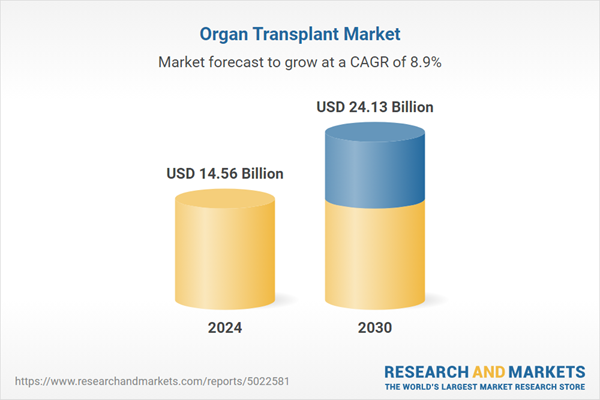
Prior to undertaking this intricate procedure, obtaining the consent of the patient or their family is of utmost importance, as organ harvesting without consent is deemed an illegal and reprehensible act. For instace, as of February 2024, the Health Resources & Services Administration reported approximately 103,223 individuals including men, women, and children on the U.S. national organ transplant waiting list. This high demand for transplant procedures in major countries is expected to significantly drive market growth during the forecast period.
Key Market Drivers
Growing Organ Failures and Organ Donations Procedure
The demand for organ transplantation has been on the rise globally in the past decade. This can be attributed to the increased prevalence of vital organ failure, higher success rates of transplantation, and improved post-transplant outcomes. The incidence of organ failure has also increased due to factors such as alcohol consumption, substance abuse, and unhealthy diets leading to chronic diseases affecting vital organs like lungs, kidneys, and liver. Organ transplantations have become a life-saving measure for patients, which is driving the growth of the transplantation market. The technological advancements in transplantation methods are contributing to the overall market revenue growth.
The increasing prevalence of chronic diseases leading to organ failures is a significant driver for market growth. The global rise in organ donation has also influenced people to opt for organ transplantation, thereby accelerating market expansion. The the excessive consumption of alcohol and unhealthy dietary habits among the population contribute to organ failure, further augmenting market growth. The proliferation of personal insurance, coupled with lifestyle factors contributing to the burden of illness, is projected to bolster market growth. The procurement and preservation of organs and tissues are expected to provide further impetus to market expansion.
In March 2023, the Pan American Health Organization (PAHO) and Spain's Ministry of Health signed an agreement aimed at strengthening the organ donation and transplantation sector in the United States. This collaboration seeks to enhance healthcare systems, share best practices, and promote policies that increase organ availability, ultimately addressing the growing demand for transplants across the country. This strategic partnership highlights the importance of international cooperation in overcoming organ shortages and improving transplant outcomes.
Key Market Challenges
Transplant Rejection
Transplant rejection is a complex process whereby the recipient's immune system mounts an attack against the transplanted organ or tissue, recognizing it as foreign. Three types of rejections are commonly observed: hyper-acute rejection, acute rejection, and chronic rejection. Despite meticulous donor matching, tissue typing, and the use of immunosuppressive medications, instances of transplant rejection still occur, leading to organ failure. Non-compliance with immunosuppressive drugs remains a significant contributing factor to rejection.
Complications that may arise from transplant rejection include certain types of cancers, infections, impaired function of the transplanted tissue or organ, and adverse effects due to incorrect medication dosages. According to the Organ Procurement and Transplantation Network, approximately 4% of deceased donor kidney transplants experience failure within one year, while living donor kidney transplant recipients face a 14% failure rate at five years post-transplant. Consequently, these factors pose challenges to the growth of the market.
Key Market Trends
Advances In the Technology and Development
Advances in technology and development have the potential to significantly boost the demand for organ transplants in the future by addressing some of the challenges and limitations currently faced by the field. Progress in technology and advancements in the medical field have facilitated the transplantation of vital organs like the heart, kidney, liver, lungs, and various other organs.
Key technical achievements encompass the development of vascular anastomosis techniques, effective management of the immune response through chemical immunosuppressants, and the formulation of preservation solutions. For instance, in June 2023, 3D BioFibR introduced ?CollaFibR, a bio-ink additive, and CollaFibR 3D scaffold, an advanced collagen fiber product designed for bioprinting tissue and organ models. These innovations aim to enhance the precision and functionality of bioprinted structures, supporting the development of next-generation solutions in regenerative medicine and transplantation.
These advancements can improve organ availability, enhance transplant success rates, and expand the possibilities for transplantation. Technology has the potential to improve organ preservation and transportation methods, enabling organs to remain viable for longer periods before transplantation. This can lead to more efficient organ allocation, reduced wastage, and broader access to viable organs. Advances in bioprinting and tissue engineering are enabling the creation of bioengineered organs and tissues in the laboratory. This technology has the potential to address organ shortages by producing organs on demand, reducing the dependency on donor organs.
Developments in immunosuppressive medications can lead to more targeted and effective treatments that minimize the risk of organ rejection. Improved immunosuppressive protocols can increase the success rate of transplant surgeries and reduce the need for high doses of medication. Research into xenotransplantation, the transplantation of organs from animals to humans, holds the potential to overcome the shortage of human donor organs. Advances in genetic editing and immunomodulation are making xenotransplantation more feasible and safer.
Key Attributes:
| Report Attribute | Details |
| No. of Pages | 180 |
| Forecast Period | 2024 - 2030 |
| Estimated Market Value (USD) in 2024 | $14.56 Billion |
| Forecasted Market Value (USD) by 2030 | $24.13 Billion |
| Compound Annual Growth Rate | 8.9% |
| Regions Covered | Global |
Report Scope:
Key Market Players
- Abbvie, Inc.
- Arthrex, Inc.
- Zimmer Biomet
- Medtronic plc
- Novartis AG
- Stryker Corporation
- 21st Century Medicine
- BiolifeSolutions, Inc.
- Teva Pharmaceuticals Industries Ltd.
- Veloxis Pharmaceutical Inc.
Organ Transplant Market, By Product:
- Tissue Products
- Organ Preservation Products
- Transplant Diagnostics
- Immunosuppressant Drugs
- Others
Organ Transplant Market, By Application:
- Organ Transplantation
- Tissue Transplantation
Organ Transplant Market, By Type of Transplant:
- Autograft
- Allograft
- Others
Organ Transplant Market, By End User:
- Hospitals
- Transplant Centers
- Others
Organ Transplant Market, By Region:
- North America
- United States
- Canada
- Mexico
- Europe
- France
- United Kingdom
- Italy
- Germany
- Spain
- Asia-Pacific
- China
- India
- Japan
- Australia
- South Korea
- South America
- Brazil
- Argentina
- Colombia
- Middle East & Africa
- South Africa
- Saudi Arabia
- UAE
For more information about this report visit https://www.researchandmarkets.com/r/3qqzi1
About ResearchAndMarkets.com
ResearchAndMarkets.com is the world's leading source for international market research reports and market data. We provide you with the latest data on international and regional markets, key industries, the top companies, new products and the latest trends.
Attachment
