Dublin, Nov. 12, 2025 (GLOBE NEWSWIRE) -- The "United States Fertilizers Market Report by Type, Category, Form, Application, Crop, States and Company Analysis, 2025-2033" report has been added to ResearchAndMarkets.com's offering.
The United States Fertilizers Market is expected to reach US$ 42.65 billion by 2033 from US$ 27.42 billion in 2024, with a CAGR of 5.03% from 2025 to 2033
Regional demand varies across the U.S., with California emphasizing specialty crops, Texas leading in large-scale grain farming, Florida focusing on horticulture, and the Midwest dominating row crop fertilizer consumption due to vast agricultural acreage. High needs for agricultural production, improvements in fertilizer formulation technology, and the growing use of precision farming are the main factors propelling the market. Due to their vast cultivation and nutrient requirements, grains and cereals are key consumers, driving up the fertilizer market share in the United States. Key categories of the market include chemical and dry fertilizers.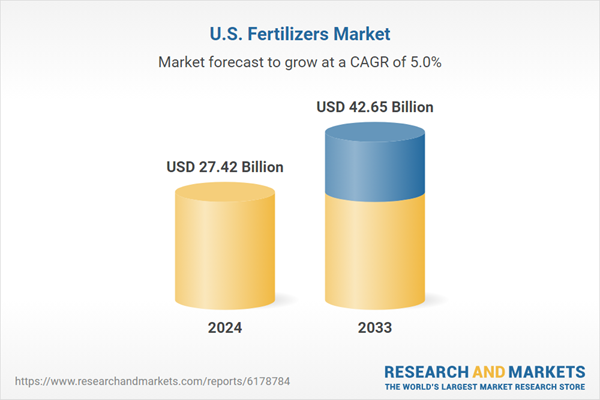
The United States Fertilizers Market is witnessing stable growth as agriculture remains a cornerstone of the country's economy. Fertilizers play a critical role in ensuring food security by enhancing soil fertility and supporting crop yield optimization. The demand for nitrogen, phosphate, and potash fertilizers continues to rise due to intensive farming practices and the need to meet growing food consumption. Increasing adoption of precision agriculture and smart farming technologies is transforming fertilizer application methods, allowing farmers to optimize nutrient usage and minimize waste.
Additionally, government initiatives promoting sustainable agricultural practices and soil health management are encouraging the use of eco-friendly and slow-release fertilizers. Technological advancements in formulation and blending have further enabled customized solutions tailored to specific crops and regional soil conditions, fostering efficient nutrient delivery.
The market is also benefiting from the expanding horticulture, biofuel, and organic farming sectors. The shift toward environmentally responsible agriculture is boosting demand for bio-based and organic fertilizers, reducing dependence on synthetic chemicals. Rising awareness among farmers regarding nutrient balance and soil management has increased the adoption of integrated fertilizer management systems.
The involvement of agricultural cooperatives, research institutions, and private players is supporting education and awareness about proper fertilizer application techniques. Moreover, the integration of digital platforms for monitoring soil health and crop requirements is facilitating real-time decision-making, driving productivity and profitability. Export opportunities for fertilizers and raw materials further contribute to the overall market potential.
The growth of the biofuel industry, which increases the production of feedstock crops like corn and soybeans, is another significant factor. For example, as of January 2024, U.S. renewable diesel and biofuel manufacturers had a total capacity of 4.3 billion gallons annually, up 1.3 billion gallons from 2023, according to the U.S. Energy Information Administration. Fuel ethanol, mainly made from maize kernel starch and mixed with gasoline, accounts for most of the biofuel production capacity in the United States.
In order to maintain soil health and promote crop growth, this need results in a higher need for fertilizers. In addition, significant soil deterioration and changing climate conditions require the use of specific fertilizers to reduce adverse impacts and improve resilience. Because consumers prefer responsibly obtained agricultural products, the use of specialty and organic fertilizers has also increased. Furthermore, increasing funding for agricultural R&D initiatives makes it easier for fertilizer products to advance, which accelerates the growth of the US fertilizer market.
Key Factors Driving the United States Fertilizers Market Growth
Increasing Adoption of Precision Agriculture
The growing adoption of precision agriculture is significantly driving fertilizer demand in the United States. Advanced technologies such as GPS-guided equipment, drones, and soil sensors are enabling farmers to apply fertilizers more efficiently based on real-time soil and crop data. This targeted approach not only optimizes nutrient use but also minimizes environmental impact and reduces input costs.
Farmers can customize fertilizer applications to meet specific crop requirements, ensuring balanced nutrition and improved yields. Government support for digital farming tools and sustainable practices is accelerating this transition. Additionally, the integration of artificial intelligence and data analytics in farm management systems allows better forecasting of nutrient needs. As precision agriculture continues to expand, demand for customized, slow-release, and controlled fertilizers is expected to rise, fostering productivity and long-term sustainability in U.S. agriculture.
Growing Demand for Sustainable and Organic Fertilizers
Sustainability trends are reshaping the U.S. fertilizer industry, with rising demand for organic and bio-based fertilizers. Consumers' growing preference for chemical-free food has encouraged farmers to shift toward environmentally responsible cultivation practices. Organic fertilizers derived from compost, manure, and natural minerals are gaining traction due to their positive impact on soil structure and microbial activity. Federal and state-level initiatives promoting regenerative agriculture and carbon-neutral farming are further supporting this shift.
Moreover, sustainable fertilizers help reduce nutrient leaching, soil degradation, and greenhouse gas emissions. Innovations in biofertilizer formulations, including microbial and enzyme-based solutions, are enhancing nutrient uptake efficiency. The emphasis on circular economy models and waste recycling for fertilizer production also contributes to market growth. As environmental awareness and regulatory pressure intensify, the adoption of eco-friendly fertilizers will continue to strengthen across the U.S. agricultural landscape.
Expansion of Horticulture and Specialty Crop Cultivation
The increasing cultivation of high-value horticultural and specialty crops is creating new opportunities in the U.S. fertilizers market. Fruits, vegetables, ornamental plants, and turf require precise nutrient management to maintain quality, yield, and appearance. The rising popularity of urban gardening, landscaping, and greenhouse farming has expanded fertilizer demand beyond traditional row crops. Horticulture-focused fertilizers, including micronutrient blends and water-soluble formulations, are witnessing strong adoption.
Government programs supporting diversification in agriculture and food security initiatives have encouraged farmers to shift toward nutrient-intensive crops. Additionally, the growing use of fertigation and hydroponic systems in controlled environments enhances fertilizer efficiency and reduces wastage. With the rise in consumer spending on fresh produce and ornamental plants, horticulture will remain a significant segment driving fertilizer consumption across both commercial and residential farming sectors in the United States.
Challenges in the United States Fertilizers Market
Environmental Concerns and Regulatory Pressures
Environmental sustainability remains one of the key challenges facing the U.S. fertilizers market. Excessive or unbalanced fertilizer application can lead to nutrient runoff, eutrophication of water bodies, and soil degradation. Nitrogen-based fertilizers are also linked to greenhouse gas emissions, raising concerns about climate impact. As a result, federal and state authorities have implemented strict regulations on fertilizer composition, storage, and usage. Compliance with these evolving standards increases production costs and limits product flexibility for manufacturers.
Farmers are also under pressure to adopt best management practices to reduce nutrient loss. The shift toward low-emission and biodegradable fertilizers requires substantial research and development investments. While environmental regulations aim to promote sustainability, they may also restrain short-term market growth and affect pricing competitiveness, particularly for small and medium-sized agricultural enterprises adapting to new compliance requirements.
Volatility in Raw Material Prices and Supply Chain Disruptions
The U.S. fertilizers market is highly dependent on raw materials such as natural gas, phosphates, and potash, much of which is imported. Global fluctuations in raw material availability and geopolitical tensions can significantly impact fertilizer pricing and supply. The COVID-19 pandemic and subsequent logistics challenges highlighted the vulnerability of international supply chains. Rising transportation costs and import tariffs have added further strain on fertilizer production and distribution.
Manufacturers face challenges in maintaining stable prices while ensuring profitability under volatile market conditions. Additionally, dependency on foreign sources for certain nutrients exposes the industry to exchange rate fluctuations and policy changes. These factors collectively create uncertainty for both producers and farmers. To mitigate risks, market players are increasingly exploring domestic sourcing, strategic partnerships, and long-term procurement contracts to stabilize supply and reduce cost volatility.
Key Attributes:
| Report Attribute | Details |
| No. of Pages | 200 |
| Forecast Period | 2024 - 2033 |
| Estimated Market Value (USD) in 2024 | $27.42 Billion |
| Forecasted Market Value (USD) by 2033 | $42.65 Billion |
| Compound Annual Growth Rate | 5.0% |
| Regions Covered | United States |
Company Analysis: Overview, Key Persons, Recent Developments, SWOT Analysis, Revenue Analysis
- CF Industries Holdings, Inc.
- The Andersons Inc.
- The Mosaic Company
- Wilbur-Ellis Company LLC
- Haifa Group
- ICL Group Ltd
- Sociedad Quimica y Minera de Chile SA
- Koch Industries Inc.
- Nutrien Ltd.
Market Segmentations
Type
Nitrogen Fertilizers
- Urea
- Ammonium nitrate
- Ammonium sulfate
- Anhydrous Ammonia
- Others
Phosphorus Fertilizers
- Superphosphates
- MAP
- DAP
Potassium Fertilizers
- Potash
- SOP
- Bio-Fertilizers
- Microbial
- Organic variants
Category
- Organic
- Inorganic
Form
- Dry
- Liquid
Application
- Agriculture
- Horticulture
- Gardening
- Others
Crop
- Grassland
- Vegetables
- Fruits/Treenuts
- Roots/Tubers
- Sugar Crops
- Fiber Crops
- Oil Palm
- Soybeans
- Maize
- Rice
- Wheat
- Others
States
- California
- Texas
- New York
- Florida
- Illinois
- Pennsylvania
- Ohio
- Georgia
- New Jersey
- Washington
- North Carolina
- Massachusetts
- Virginia
- Michigan
- Maryland
- Colorado
- Tennessee
- Indiana
- Arizona
- Minnesota
- Wisconsin
- Missouri
- Connecticut
- South Carolina
- Oregon
- Louisiana
- Alabama
- Kentucky
- Rest of United States
For more information about this report visit https://www.researchandmarkets.com/r/8dfgnb
About ResearchAndMarkets.com
ResearchAndMarkets.com is the world's leading source for international market research reports and market data. We provide you with the latest data on international and regional markets, key industries, the top companies, new products and the latest trends.
Attachment
